Automation
Build a Landing Page That Converts
Don’t Send Paid Ads to Your Homepage: Build a Landing Page That Converts
Running paid ads sounds simple: create an ad, choose an audience, set a budget, and send people to your website.
But there’s one problem.
Your website may not be designed to turn paid traffic into customers.
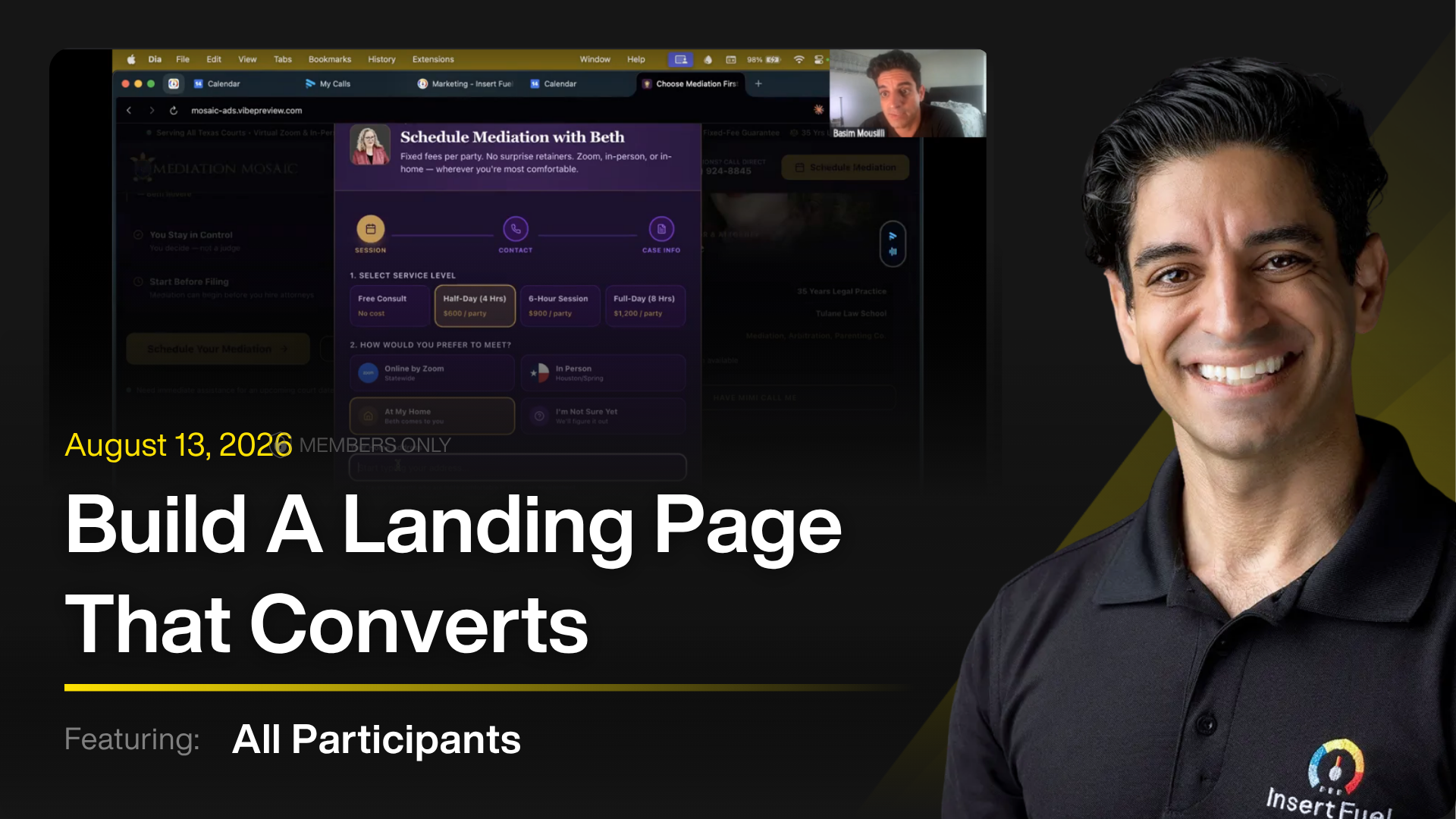
During a recent Let Go Boss coaching session, we discussed preparing a mediation business for paid advertising. Instead of changing the company’s existing websites, the strategy was to build a dedicated landing page specifically designed to turn ad traffic into booked mediations.
That distinction matters for almost any business investing in advertising.
Your Website and Landing Page Have Different Jobs
A normal website has several responsibilities. It explains who you are, showcases services, provides information, builds credibility, and gives visitors multiple places to explore.
A paid-ad landing page should be much more focused.
It should answer one question:
What do we want this visitor to do next?
In the Mediation Mosaic example, that action was clear: get qualified visitors to understand mediation as an option and ultimately schedule a mediation.
There were no competing priorities.
That is what makes a landing page powerful.
Use Your Customer’s Language, Not Marketing Jargon
One of the most interesting parts of this project was how the copy was created.
Instead of inventing generic marketing language, Basim used transcripts from conversations, a podcast-style recording, and an actual lunch conversation with the client.
The goal was to capture how the people closest to the service naturally described the problems, emotions, and benefits involved.
This is a simple strategy businesses can copy.
Record conversations with your customers and sales team. Review sales calls. Look at the questions prospects repeatedly ask. Pay attention to how customers describe their frustrations.
Then use those words in your marketing.
Your customers often write your best copy for you.
Combine Emotion With Logic
People rarely make decisions using numbers alone.
They need to understand the logical benefits of your service, but they also need to feel that you understand the problem they're experiencing.
For the mediation campaign, the landing page was intentionally designed to address both sides. It included emotional messaging alongside practical information, numbers, calculators, and a quiz, all leading toward the same conversion goal.
The same principle applies whether you're selling legal services, consulting, home services, software, or professional services.
Show people the cost of staying where they are.
Then show them what the better outcome looks like.
Don't Spend Money Until the System Is Ready
The landing page is only one part of the system.
Before launching the campaign, the team also needed client approval of the messaging, access to the Facebook account, the advertising account properly connected, and a payment method available for ad spend.
This is where many campaigns unnecessarily lose time.
The creative might be finished, but nobody knows the Facebook password.
The landing page is ready, but the client hasn't approved the copy.
The ads are built, but the payment method isn't connected.
Before spending your first dollar, make a simple launch checklist:
Landing page approved
Offer and CTA confirmed
Ad creative ready
Facebook/Instagram access confirmed
Business Manager connected
Payment method added
Follow-up emails and texts prepared
Appointment calendar working
The Mediation Mosaic team even prepared the follow-up emails and text messages before launching so the client could see the complete plan rather than discovering pieces after ads started running.
The Goal Isn't Traffic. It's Appointments.
Clicks are easy to celebrate.
Traffic looks good in a report.
But neither necessarily grows the business.
The real objective is building a system that moves someone from:
Ad → Landing Page → Follow-Up → Appointment → Customer
That's why your landing page, automation, advertising, and CRM shouldn't operate as separate projects.
They should function as one system.
At Insert Fuel, that's the approach we take: standardize the process, automate what can be automated, connect the systems, and then put fuel behind what works.
Before you increase your advertising budget, ask yourself:
If 100 ideal prospects landed on my page tomorrow, would my system know exactly what to do with them?
If the answer is no, fix the system before buying more traffic.
Keep reading
Are GHL Websites Good for SEO in 2026?
Discover if GoHighLevel websites are SEO-friendly in 2026 and learn solutions to common issues.
 Joana Maas· 5 minAI
AI Studio vs Ask AI: Key Differences & Uses
Discover the differences between AI Studio and Ask AI in HighLevel to optimize your marketing strategies effectively.
 Jek Tibayan· 5 minAutomation
The one cron job every agency should have running
There is one specific scheduled job every agency should run nightly. It catches every brand that has gone quiet, every task that has been open too long, every client whose hours are slipping. Fifteen minutes to build.
 Basim Mousilli· 4 min
Get your hours back
Which part of your week would you hand over first?
You have just finished “Build a Landing Page That Converts”. Most owners already know the answer, and it is usually the same three things: chasing people who went quiet, retyping the same information into two systems, and remembering to follow up. All three can run without you. Tell us what yours are and we will tell you honestly which ones are worth automating first.
- We start with the task costing you the most hours
- You see it working before you have to trust it
- No technical knowledge needed on your side at all
Thirty minutes, free, and you will speak to Basim rather than a salesperson. If we are not the right fit we will say so and point you somewhere better. Not ready for a calendar? Leave us a sentence instead and we will ring you.
 Previous ArticleWe'll see you at HighLevel Summit 2026 in DallasAI
 Next ArticleAI Studio: Create Pages Fast with HighLevelAI