Automation
Build It Once, Reuse Forever
Build It Once, Reuse Forever: What We Learned From This Week’s Let Go Boss Coaching Call
There was a clear theme running through this week’s Let Go Boss coaching call: the goal of AI is not simply to make things faster. It is to build systems that keep creating value without requiring the owner to do everything.
Basim opened the session with a real example of that philosophy. Insert Fuel’s new community feature had been built largely by Jek while Basim deliberately stayed out of the development work. As Basim put it, the bigger principle is simple: “Build it once, reuse forever.”
Here are some of the biggest lessons from the session.
1. A Landing Page Has One Job: Move People Forward
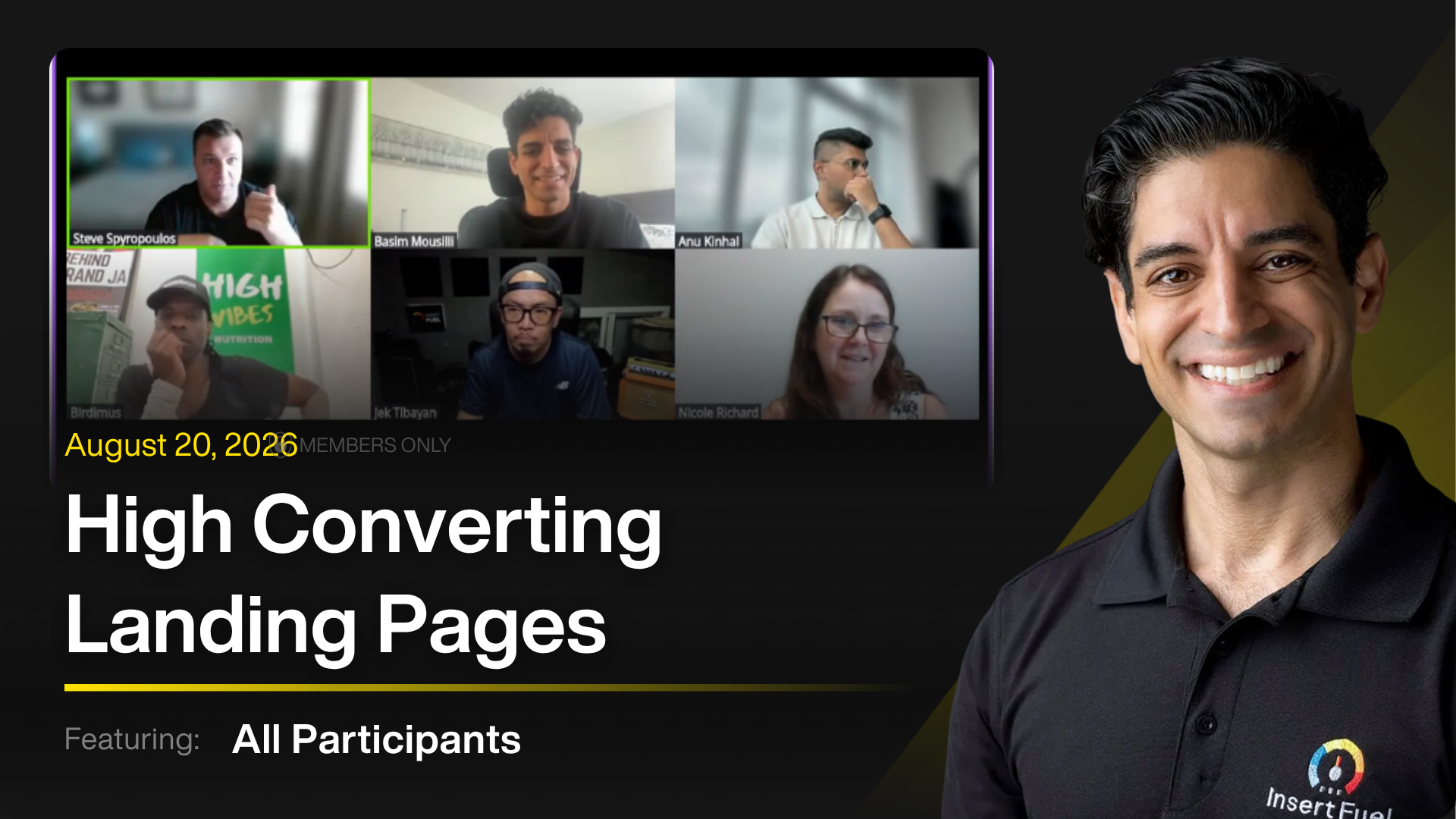
A large portion of the coaching session focused on improving Anu Kinhal’s paid-ad landing page.
The issue wasn’t simply whether the page looked good. The real questions were:
Can someone immediately understand what they are getting? Is it easy to take the next step? And are we giving them unnecessary opportunities to leave?
The existing experience had generated bookings, but some prospects were no-showing because they didn’t fully understand what they had booked or why the meeting mattered.
The team worked through several conversion improvements, including simplifying navigation, optimizing for mobile, making available appointments easier to select, explaining what happens during the strategy session, and making the value of the appointment obvious.
One particularly important change was positioning the appointment as a Trademark Strategy Session, rather than simply saying “Book a Call.”
That small distinction gives the prospect a reason to care.
The lesson is simple:
Don't optimize your website for more clicks. Optimize it for fewer decisions and a clearer next step.
2. Build Your Own Tools When the Problem Keeps Repeating
The second major announcement was the new community platform built directly into the Insert Fuel OS.
Instead of relying entirely on another community platform, the team built its own system where members can post questions, wins and goals, interact with one another, report bugs, and eventually create their own communities.
Why build it?
Because the team wanted coaching, questions, memberships, tasks, homework, live interactions and community activity to eventually work together instead of being scattered across separate tools.
This is an important automation principle:
When you solve a recurring problem for yourself, ask whether the solution can become a reusable system for your customers too.
That is how internal tools can eventually become products.
3. Your First Customer Is About More Than Revenue
Steve shared an important ResiFix update during the call.
After building and improving the software, he had connected with people who knew residential contractors and was preparing for a demo that could produce ResiFix’s first real customer. His plan was to use that first relationship to create referrals and gradually build a customer base.
Basim’s advice was to focus heavily on getting that first customer and turning the experience into proof.
Early on, a testimonial and case study can sometimes be more valuable than maximizing the first transaction. Instead of automatically giving work away for free, Basim discussed using significant introductory discounts to reduce the barrier while still establishing value.
The first customer gives you something your prototype cannot:
proof that somebody outside your team actually wants what you built.
4. AI Lets You Build, but You Still Need to Understand What You Built
Steve’s progress with ResiFix was also an example of what Let Go Boss is trying to accomplish.
He built the application himself using AI and vibe coding rather than having the Insert Fuel team build the software for him. Basim pointed to the same thing with Anu’s landing page: the members were learning to create and improve their own systems.
But there was also an important warning.
Steve shared that an improperly protected AI API key had been exposed. According to Steve, the compromised key was hit millions of times within hours and generated unauthorized usage charges.
The takeaway: AI lowers the barrier to building software, but it doesn't eliminate the responsibility to secure and understand what you deploy.
5. Community Is Part of Letting Go
One of the most meaningful moments of the call had nothing to do with software.
Marcus “Birdimus” Bird shared an update about a long-running personal project and thanked Steve for supporting and mentoring him outside the weekly calls. Their relationship had developed through the community.
That demonstrated another version of “Let Go Boss.”
You don't have to solve every problem alone.
A useful community isn't just an audience listening to one expert. Members teach each other, share what worked, provide support and eventually become resources for other members.
That is also why the new community platform is being designed around members contributing answers, goals, wins and knowledge rather than simply consuming content.
The Bigger Lesson: Create Multipliers
This coaching session connected several seemingly different projects: a legal landing page, a community platform, ResiFix, vibe coding and customer acquisition.
But they all pointed toward the same idea.
Stop building things that only work when you are personally operating them.
Build a landing page that guides the prospect.
Build software that handles a repeated process.
Build a community where members help one another.
Teach someone to use AI instead of doing every task for them.
Turn the first customer into a case study that helps win the next customer.
That is how automation, delegation, AI and community begin working together.
And that is what it really means to Let Go, Boss.
Keep reading
Are GHL Websites Good for SEO in 2026?
Discover if GoHighLevel websites are SEO-friendly in 2026 and learn solutions to common issues.
 Joana Maas· 5 minAI
AI Studio vs Ask AI: Key Differences & Uses
Discover the differences between AI Studio and Ask AI in HighLevel to optimize your marketing strategies effectively.
 Jek Tibayan· 5 minAutomation
The one cron job every agency should have running
There is one specific scheduled job every agency should run nightly. It catches every brand that has gone quiet, every task that has been open too long, every client whose hours are slipping. Fifteen minutes to build.
 Basim Mousilli· 4 min
Get your hours back
Which part of your week would you hand over first?
You have just finished “Build It Once, Reuse Forever”. Most owners already know the answer, and it is usually the same three things: chasing people who went quiet, retyping the same information into two systems, and remembering to follow up. All three can run without you. Tell us what yours are and we will tell you honestly which ones are worth automating first.
- We start with the task costing you the most hours
- You see it working before you have to trust it
- No technical knowledge needed on your side at all
Thirty minutes, free, and you will speak to Basim rather than a salesperson. If we are not the right fit we will say so and point you somewhere better. Not ready for a calendar? Leave us a sentence instead and we will ring you.
 Next ArticleWe'll see you at HighLevel Summit 2026 in DallasAI